There exists a bedroom closet in my parents’ house where I have stored, over the years, a sizable number of boxes holding things of mine that have not been sensible to carry with me as I maintain a studio-sized lifestyle. But neither are they things I could bear to let go of, a reality I skillfully avoided confronting for years due to the generosity and long-suffering of my parents.
Usually, I hold onto things because of my emotional investment to them. But I have ethical conflicts about throwing things away, too. Once, I found one of those gooey gag eyeballs while cleaning and before I could throw it away I needed to spend the next fifteen minutes throwing it repeatedly against the wall until all its stickiness was used up and it became nothing more than a sad little clump of unrecyclable petroleum product. This was all done in order to console myself when I put it in the landfill that at least its little, silly, useless purpose had been fulfilled. And even then I felt guilty for throwing it away.
But this past Christmas, I began the process of finally moving the boxes out of my parents’ home. And as I began to cull the closet, I was immediately sucked into a wormhole of nostalgia. If you wrote me a letter between the ages of 7 and 21, it was likely in one of those boxes. As were postcards from summer camp. Photos. Birthday and greeting cards–from my parents, brother, friends, and even my dog (written in my mother’s handwriting). Old team jerseys. Things, which out of context, were simply strange. Like the sixth grade group project involving a bed sheet painted with a surreal landscape of trees, zombie children holding torches, and a pile of books about to be set on fire. Although suggestive of potentially deep meaning, I’m not sure now what we were trying to do there.
I also kept a lot of random bits and pieces of things with no clear purpose or context anymore: bolts, paper clips, dead pens. And keys. I hold an enduring resistance to throwing away a key without its lock to call home. Because if I throw the key away, then the lock to which it belongs can never be opened again if it should ever be found. And the idea of a lock that can never be opened breaks my heart. Okay, okay–I know I could call the locksmith. But still. A lock without its key just feels wrong.
And then there were the little soaps. A small handful of star and heart-shaped capsules filled with bubble bath soap. I don’t remember who gave them to me. But to whoever did–thank you. They are lovely. They were too lovely. When I was younger, they were supreme little treasures I never felt ready to relinquish into the water. I kept waiting to use them, believing a day would come when I would finally feel justified in taking a bath in their magic. But over twenty years later, I waited so long to use them I forgot they even existed. On this Christmas afternoon, however, I took them out of the box and put them in my purse, setting a New Year’s intention to take that bath sometime in the next twelve months.
Clearly, it is only through great effort and will that I have not become a full-blown hoarder. Even as a child I showed hoarding tendencies. My parents did everything they knew how to help me learn how to keep and order my environment. They encouraged, cajoled and even punished. Once, my mother ordered me to my room for as long as it took for me to clean it. The mess at that point had gotten so bad that you couldn’t really see the bedroom floor. Sullen but resolved, I began the work of putting my room in order, starting with what was clearly the most important task of all: color-coding the clothes in my closet. (That decision just about sums up my ability to manage my physical environment.)
I soon became absorbed in the task in making a beautiful rainbow out of my clothes. Once that was finished, I sat down and began to go through drawers of papers to throw them away. But again everything felt too meaningful–too precious to let go of –and as that wormhole of nostalgia opened up in my mind (I was nostalgic even as a child) I spent the next couple of hours basically getting nothing done. It’s very possible that some of things I have, until recently held onto–including those little soaps–were some of the same things that passed through my hands that day. My mother found me sitting in the middle of a pile of papers. In her mind, I had been doing nothing. In my mind, I had been working very hard. Once she understood this, exasperation turned to bafflement. And eventually she surrendered the fight over my bedroom with the one concession that I couldn’t bring my mess into the rest of the house.
Twenty-something years later, it’s obvious that I am still a work in progress when I can occasionally come across an ATM receipt from a road trip I took in 2000 and then put it back in the box–and then repeat this a dozen times–because to throw away the receipt feels like throwing away a part of the road trip itself. If this were the only receipt I kept, then maybe it wouldn’t be problematic. But it is one of many among other tiny little souvenirs of days in my life I keep trying to hold onto.
The greatest treasure I re-discovered this past Christmas, however, was something I had remembered dearly but feared was lost forever. Crumpled and brown at the edges from lack of care, it lay unceremoniously in the midst of the bits and pieces of my childhood. With great delight, I gently pulled a delicate lace necklace out of the box. I ran my fingers across the fabric looking for any damage and was deeply relieved to find it still whole, this gift from my grandmother who tatted the necklace for me when I was only twelve or thirteen. At the time, I was too young to appreciate the beauty and value of her gift. I thought it was too old-fashioned and girly. I couldn’t see what an extraordinary craftswoman my grandmother was or appreciate the beauty of a dying art like tatting. Tatting is similar to crochet but with much smaller–incredibly small–loops of fabric hooked together with other incredibly tiny loops of fabric to make strong but lacy works of art. Like other domestic arts from the generations of our grandmothers and their grandmothers, tatting requires patience, precision, and time–three things modern life seems to be evolving without.
But with a little bit of wash and care, my necklace was restored to its crisp whiteness. Laying it flat on a kitchen towel to dry, I chided myself for having been so careless while also cherishing what was, in truth, a rare Christmas present from my grandma. She hasn’t been well enough for years to make something like this. My mother and I were planning to make a trip to see her the following day and I was looking forward to telling her in person how much the necklace meant to me, how I would always treasure it, and how precious it is to me that she made it for me with her own hands.
But my grandma wouldn’t let us come over. One of her cats was sick.
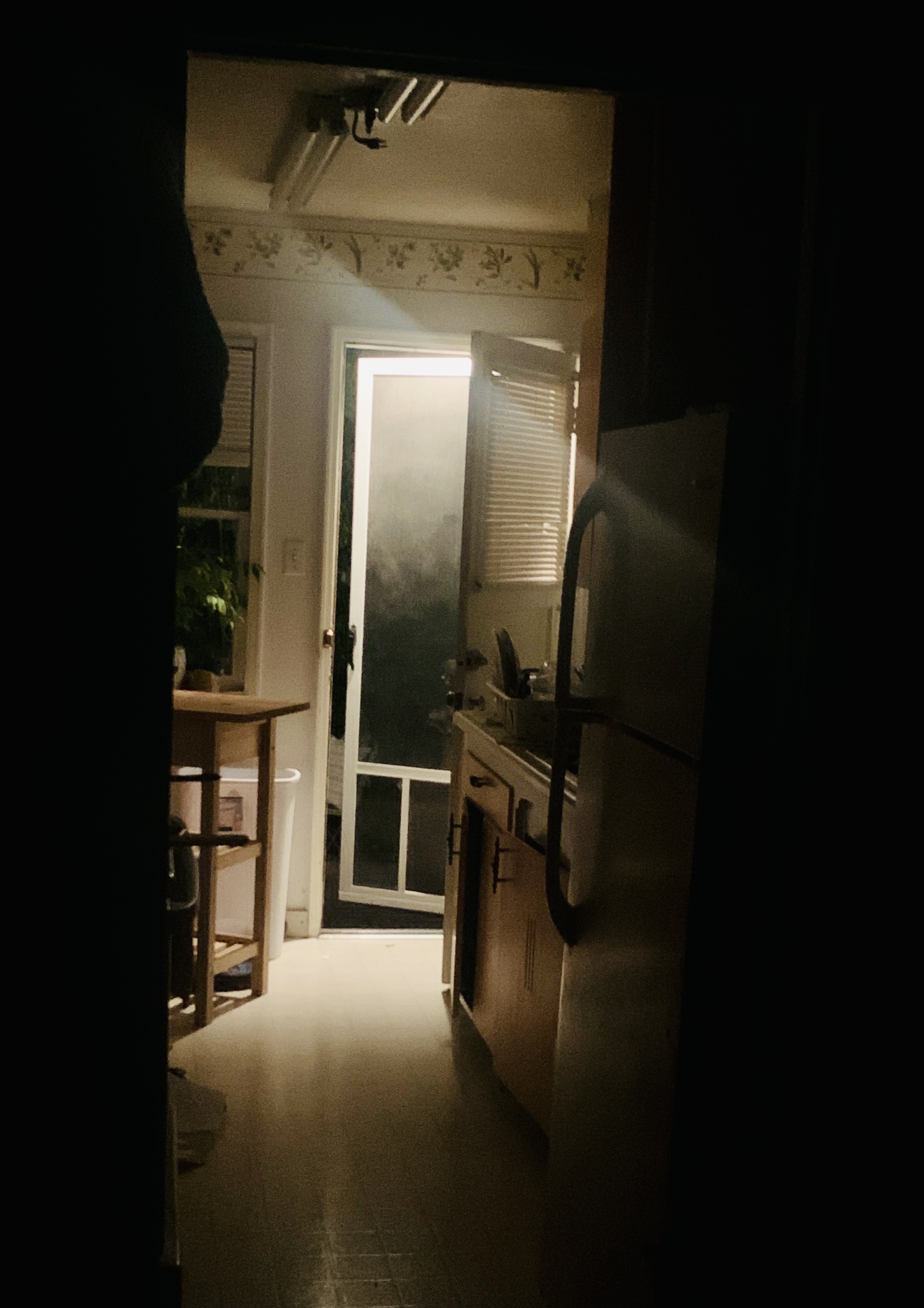
Sometimes my grandma lets us in to the house. Sometimes she doesn’t. Her house is a small pink stucco tract home made smaller by halls clotted with years of hoarding. It hasn’t always been in this condition. In one of our family albums there are pictures from my third birthday party which my grandma hosted–unbelievable as it seems to me now–in that same house. I have no memory of the open spaces on her living room floor whose existence those photos undeniably prove. Because by the time I could remember them, those spaces with every other part of the house had been taken over with clutter. With the unstoppable force of a glacier, things piled upon things which collided with other things. And this mitosis of stuff grew hungrily and exponentially. There came the day, for example, when she was no longer able open a door to one of the back bedrooms because a mountain of junk began to push back against it from the other side. Still, as long as she was able, my grandmother pushed open the door as far as she could and threw whatever fit in the open gap until the day the crack closed and the door became a wall.
On those days when my grandmother would let us in, we carved out tight spaces on the couch or simply remained standing. We all tried in one way or another but any offer to help her clean and organize was always rebuffed. Any attempt to reason with her was cut off at the pass. There was no point in resisting her. No, she wasn’t ready to let go of any of those yellowing newspapers because there were stories she still wanted to read and coupons to clip out. And in fact, buying the same butterfly lamp seven times when it was on sale was actually saving money. Likewise, she had plans for those dozens of bolts of fabric in the hallway closet, even after they began to mildew.
My grandfather–the fourth of my grandmother’s husbands and the first to love her without demons of addiction or abuse driving his mind–eventually realized the futility in trying to change his wife; after arguing with her for years about the state of their home he seemed to retreat to the family room. There he staked a circle of personal space large enough for his armchair and TV tray. A kind and simple man, he worked for decades as a truck driver until the day he retired–mostly to that room where it seemed to me that he watched an endless stream of Kung Fu movies and westerns. When I think about it now, the fact my kind and simple grandpa spent so many hundreds of hours watching fight scenes in solitude makes me wonder whether he was working out, in his own quiet way, the unwinnable fight in his own home.
And then there were the cats. So many cats. By the dozens, feral and neglected cats found shelter in her home. My grandmother could never turn one away, especially black cats. The cats no one wanted my grandmother did. Vet bills were a constant as was the endless stream of feline refugees. But they mostly stayed hidden in the cat-sized caverns made by interlocking piles of boxes and bins so you never saw all of them at the same time. I am grateful for this. Because even though I like cats just fine, I find something very disturbing about cats gathered together in large numbers. What constitutes a creepily large number of cats, however, is entirely subjective. Like, say, if I am around more than four cats at a time I begin to feel like I am in a Hitchcock film. But for people like my grandmother that limit is never reached. She once remarked that she stopped counting after she reached thirty. Cats.
Those cats were some of the luckiest creatures I’ve ever known, too. Their well-being came first above all else, it seemed at times. My grandma didn’t like to leave the cats alone for too long. This meant that she often couldn’t make it to a family gathering or, if she did, would have my grandpa drive them home early. Her presence at a graduation or birthday party was always notable because it wasn’t expected. Not that she wasn’t expressive of love towards her family–I’ve heard her say “I love you” many times. It was just that the cats had her full love and attention.
But even before the cats moved in, the attentions of my grandmother’s heart were elsewhere. Though my mother has a beautiful singing voice and for much of her life has sung in public either as a soloist or in a choir, my grandmother has never heard her sing. What makes a woman rush home to care for her cats but never make the effort to hear her daughter sing?
If my grandmother wouldn’t come to us as often as we would like, we tried to go to her. But with my mom and brother both being allergic to cats it usually made more sense for everyone to meet outside. Once, while I was still in high school, I made one of those visits with my mom. We waited for my grandma on the front porch which was overwhelmed by cans of cat food, garbage bins, and newspapers. From inside the house, she directed us to lawn chairs in the backyard, a place overgrown with plant life. My grandmother had an immense green thumb–at least, in the beginning of a plant’s life. Her plants would grow for her and she would adore them in turn. But she had a hard time keeping them tame. Without nurture and discipline, her plants tended to behave like spoiled children, doing and growing as they pleased until the backyard resembled a botanical version of The Lord of the Flies.
On this day, I unadvisedly wore sandals to the house and my poor planning left me trekking through the flooded grass of her backyard doing my best to avoid the floating corpses of dead earwigs that threatened to lodge themselves between my toes. My mom and I sat down in the lawn chairs, tapping our feet to shake off the flies. One of any number of black cats weaved between my ankles.
My grandma made her way outside, slowly and with great labor as walking was becoming more painful for her with the passing of every year. We talked. My mother’s voice was light with weather and plants and jobs and health and houses–but there were moments when I thought I could hear her voice shake.
As much as I feel a complicated mix of love, frustration, and sadness for my grandmother, I can only imagine how much more complicated it must be to be one of her children when they are all survivors of the same war. My mother’s father–my grandmother’s second husband–waged every form of violence on his family for years. Why some people face the same brutal realities of life but find radically different ways of surviving them due to an imprecise and complex intermingling of genetics, circumstance, and free agency is an observable but mysterious phenomenon of human nature. But from the time she was a child, my mom was resolved to build a life different from the one in which she was raised in almost every way. And she did. The life she made for herself involved healthy choices and education and hard work. And she married a man who the home she created with my father was always, at its very core, safe and full of love. And clean–except for my room. My mother became the kind of mother who would do anything in her power to hear her children sing.
Needless to say, the whole scene in the backyard that day was depressing. I heard a cockatiel singing from inside the large plywood aviary at the corner of the yard so I wandered in its direction, hoping to find a little joy in the moment. Instead, I found one lone bird singing amidst piles of black droppings, shavings, and spilled bird seed–her cage appeared to have not been cleaned for months. And the aviary felt conspicuously empty as it was large enough to house many more birds than this one.
The others have all died, grandma called from over her shoulder. She was apologetic, as if this kind of bird death was beyond her power.
I couldn’t understand why she felt so helpless. Of course, my grandmother couldn’t stop her birds from dying in the ultimate sense. But she could have stopped them from dying in a state of filth. And if her own physical limitations and chronic pain made it difficult for her to provide for their care, then why keep birds at all? Why not call the pet store or animal rescue to give the birds the possibility of being re-homed? Or why not simply open the aviary door and let them fly away to at least give them the chance to fend for themselves, to live and die in wild, fresh air?
As much as it angered me, the helplessness I heard in her voice was painfully familiar. I’ve never known her to talk for very long without it. It is a deeply weary sound that I am now certain vibrates in the range of clinical depression. And it was a sound that was becoming familiar to me for other reasons as I could hear it beginning to creep into my own voice like vines growing in my grandma’s backyard.
Years later, when I was in my early thirties, I sat down in my therapist’s office for the first time and began to learn more about what my grandmother and I share in common. My depression has never been as severe as my grandma’s. But neither have I had to survive the traumas and losses she has in her life. I don’t know who I would have become if my biology had met her circumstances. Poverty. Violence. The death of a son.
Still, my depression had its own kind of claws. On the first day of my second year of seminary, my first thought upon waking up was to wonder if this was going to be the year I would finally kill myself. Living on the top floor of a four story building, more than once I had to push away the thought that it would be a terribly easy thing to do.
It’s strange to me now how even in light of several soul-crushing periods in my life like this one, I didn’t think my depression was that serious. I told almost no one the extent of my inner torment. Ashamed, I always thought it was my doing. If only I could think think better, be stronger, try harder. Apparently, I had my grandmother’s biology and my mother’s self-reliant attitude. This combination ultimately did not serve me.
On occasion, I sought help. But for the most part the help I received was validation that my depression wasn’t really depression or that it was entirely in my hands to change. My freshman year at a Christian college, when I spent almost every free hour outside of class doing a face plant on my dorm room bed listening to U2’s “Achtung, Baby” on repeat, I ventured to share my struggles with a few other students who lovingly explained to me that if I was depressed that I just needed to read my Bible more and pray harder. Instead of choking them with my insufficiently prayerful hands, I went to the campus counseling center to ask for help. But there the counselor told me I most likely had ADHD and suggested I take tests towards that end. Even in the moment, I found her suggestion absurd. Anyone taking a good look at my squishy, slouchy, slow-moving form would have seen that hyper-activity was quite emphatically not a problem for me. So I didn’t return. But several years later, I ran into her at the grocery store. She remembered me. And without my solicitation, she apologized.
And because I was functional enough to get my work done, be a good student, and enjoy occasional moments of life, I went on thinking this was just who I was: morbid, depressive, anxious, unable to finish anything I started, painfully shy. I existed with such dysthymic regularity, I believed my depression was a part of my personality. Blessedly, it was also during my college years when I began to meet beautifully misfit friends who mirrored to me other aspects of who I was: quirky, imaginative, intense, lovable to people other than my family, and, most surprising of all to me, funny.
I may have inherited my grandmother’s hoarding tendencies and depressive wiring but I also inherited her laugh, a trait which did not skip generations and which I am happy to also share with my mom. The women in our family can laugh. Big, bold, throw-your-head-back, make-your-body-shudder-until-you-can’t-speak kinds of laughs. And how I love to hear my grandma laugh! Partly because of the beauty of the sound and partly because of how rare it is to hear it. Her laughter pulls all my attention to it, like the cockatiel singing in her backyard did to me that day years ago. Her laughter pulses with brightness and power that speaks of a life force in her that was strong enough–for long enough–to once leave a horribly abusive marriage and to raise four children on her own despite those days when she couldn’t even get out of bed. It is a life force which turned her hand, for moments at a time–to painting beautiful landscapes, planting lush gardens, and tatting intricate gems of yarn. But like an unpredictable geyser, the heat and force of her laughter and life stay mostly underground.
I believe in the saving power of laughter. When your life force been living in the dark for so long, laughter can be like putting a spotlight on it. Laughter can show you the places in your heart where you come alive and feel safe to be yourself. Of course, that’s just the beginning. Laughter can give you a map to those places but figuring out how to move there permanently can be a difficult, long, and uncertain pilgrimage. The first time I ever tried stand-up comedy, for example, was also during the darkest period of my life. Strangely, there was a kind of freedom that came with that level of despair. Because when I happened to meet my friend Tim and find out that he was a stand-up comic and then he told me about a local open mic, it didn’t take long for me to say: Fuck it. What do I have to lose? I didn’t know it at the time but taking that leap was one of the most important steps I will ever take on that journey home to my own heart. Stand-up comedy was like hooking a hose to an inner hydrant; the release of life force was immense.
But stand-up comedy didn’t conquer my biology. When I finally decided to take an anti-depressant for the first time, I did so because nothing else was making a difference. No matter how much I prayed, talked, read self-help books, or told jokes I was still held down by depression. For years, I fought against the idea of anti-depressants believing I would be weaker for their use. Then I heard something that changed everything, an episode of the podcast “On Being with Krista Tippet.”
The title of the episode was “Soul in Depression.” And in it, I heard spiritually insightful, creative, compassionate people speak openly about their own battles with depression. For years, I had been conditioned to see my spiritual life as something separate or superior to my emotional life. As though my belief in God should have been enough to fix my brain. Anything less was an admission of spiritual failure. Yet, in this conversation between spiritually minded people who lived with depression, I heard a general consensus that though medicine was by no means a cure all for any of them, medicine had not caused them to lose themselves but to actually become themselves. After listening to the podcast, I picked up my phone and started looking for a therapist. Though it was hard for me to shake the feeling that I was a failure, I decided I had nothing left to lose. Another leap of faith I will never regret.
One morning, ten days or so after I started taking Wellbutrin, I found myself washing dishes at the kitchen sink. This may not seem like much to most people. But for me it was a watershed moment. Everything about washing those dishes felt different. All of the effort it once took to do the dishes was, in that moment, gone. A similar moment happened while walking my dog one afternoon and I became overwhelmed by the feeling that I was enjoying the simple act of, well, walking my dog. The restless energy that bubbled through my veins for years in search of some measure of direction and peace was now being tamed and leashed. Little by little, I was beginning to discover what it meant to simply feel good being alive.
If you’ve never experienced it, it’s hard to explain what a difference I felt standing at my kitchen sink that day or walking my dog on such an ordinary afternoon. Where I grew up in the San Joaquin Valley, the winters are often characterized by dense fog. And without knowing it, I had spent years of my life living with a mind covered by a dense fog. On some days the fog lifted and visibility improved significantly. But it was always winter inside. The fog was always there hovering over me, obscuring my view, impeding my movements. And I believed this was just the way the weather was supposed to be all year round. With the addition of medicine, I felt like Neo from The Matrix after taking the red pill, except I woke up in a world with more clear blue sky than the one I had been living in before.
(I say this knowing how incredibly lucky I am to experience such success with anti-depressants on the very first try and wishing the same could be true for everyone who lives with depression and appreciating that things may not always be this simple for me.)
Of course, anti-depressants didn’t solve everything for me. In some ways, things got much harder for me once I had the energy to look at my life and make the necessary changes to follow in the direction the laughter in my heart was pointing. Therapy intensified. I wept more in one year than I had in my entire life. And in time, the changes I was making within meant leaving my marriage. Anti-depressants didn’t turn off my confusion or fear or the intense grief I felt as I knowingly broke the heart and devastated the trust of someone I loved. Nor did they quiet my soul’s mandate to give everything I had towards following this brightening inner light into a murky and uncertain future on my own. But anti-depressants lifted the floor of my despair to a bearable height. The chasm became a well. On my lowest days, I could still look up and see light. And a ladder out of the hole.
And as my depression began to lift, I began to let things go. And I as began to let things go, my depression began to dissolve with them. How one affected the other I cannot precisely know. But in less than a year, I released nearly 3/4 of everything I owned–to date, this is the least American thing I have ever done. I even finally let go of that road trip receipt. And the paring down only continued until I was essentially left with some books, clothes, and several bins. In great part, this came as a consequence of needing to downsize my life post-divorce. My Honda made multiple trips to the Goodwill. And I learned that I could put almost anything on the curb and it would be gone within an hour.
But the letting go went deeper than that, all the way into those boxes in my parents’ closet, all the way into my most cherished ideas and beliefs about love and life. The letting go continues, challenging me now with the reality is there is no end to the letting go–time pushes forward. And there is no souvenir that can capture the preciousness of each moment as it passes through me. Hoarders are correct about one thing: every thing and every moment is precious. But hoarding isn’t the way to honor that reality. In fact, if you hold onto everything then nothing will have its own chance to live and breathe. The things you love most will get lost beneath heaps of other things you love most until you forget what it is that you loved most. If the handful of star and heart-shaped soaps are too precious to let go of into the water, then you will never feel the fullness of their soapy, bubbly, fragrant preciousness on your skin. And very likely, in your effort to preserve their beauty, they will be lost and forgotten all together. As awful as this reality once seemed to me–a reality I am still struggling to accept–I am learning that if I want to learn to truly love life, I cannot hold onto it.
And on the other side of having taken the red pill–of having a direct experience of the changeable biochemistry of my mind–I am beginning to see my grandmother differently. My mom tells me that grandma didn’t always hoard like this. That things only got worse after my mom’s older brother Jimmy–my grandmother’s eldest–died when I was only a baby. Evidence of my grandmother’s depression was always there. But her hoarding only worsened with profound, intractable grief. And the empty space in her home that only exists now in pictures became synonymous with the hole in her heart–trying to fill one by filling the other.
So where I once only saw eccentricity and mental illness, I now look at those piles of things in my grandma’s home, this ever-growing mountain of stuff that will rot in a landfill one day without ever having been used, and I see a dam holding back an enormous river of love. I see her hoarding love, tucking it away in boxes and corners, not because she is at her core selfish although it can feel this way sometimes. But because she has already lost one of the most precious loves of her life, the cost of continuing to bear that love in the absence of her son’s physical presence is too much for a heart conditioned for decades by the helplessness of depression. Without ready or easy access to the life force required to live on despite such loss, it is easier for her to disperse both her love and loss through an infinite mountain of things and cats that she can hold to with every part of her being. Even though it means the energy she requires to hold onto those things entombs her with them, closing off a large part of her heart to the people who love her.
In the end, I can’t really know. At least, not with the information that is available to me. So maybe I am creating a story to help me find my own peace as it is hard for me to see my grandmother and not wonder who she could have been–who I would have been–had biology and circumstances converged differently.
She may hoard her love. But it still leaks out. I remember this now every time I hold the lace necklace.
And I finally take that bubble bath.


 Heather Isaacs
Leave a reply to Lisa Cancel reply