“Here in California, fruit grows heavy on the vine. There’s no gold, I thought I’d warn ya. And the hills grow brown in the summer time,” Kate Wolf.
Sometimes you hear a song for the first time and it knocks the wind out of you because it gives voice to something you have needed to feel or say or know but did not know how. Then you wonder how it is that this song has existed for years but you are only now hearing it? Was it medicine that only came to you when you were sick enough to need it? Last week, I had one of those moments when I heard Kate Wolf’s song, “Here in California,” for the first time. I happened to be with one of our hospice music therapists to see a patient. And because the patient loves Kate Wolf’s music, the music therapist had been learning some of her songs to bring into their visits together. Hearing “Here in California” for the first time, I could feel the way it cracked open my own grief. But being there to support our patient, I could not give space just then to let it undo me completely.
Sitting with the song since then, beginning to learn it for myself, letting it play over and over again in the car, I realize that it was the song I needed for the heartsick hope I feel for this moment in time: this tenuous moment of slowly emerging out of pandemic survival mode within the tenuousness of spring in California, a time when everything turns green for a heartbeat while the land is, more often than not, bone dry, a time when fire season feels like a hungry mountain lion watching from a strategic distance, ready to pounce.
Wolf’s lyrics, which includes conversations between a mother and her child and between potential lovers, weaves together personal love and loss to the landscape of California, linking the experience of deep beauty and risk that accompanies falling in love to loving California itself, a love that is clear-eyed and truthful about our limits and wounds. “There’s no gold, I thought I’d warn ya. And the hills grow brown in the summertime” applies both to life in California and the work of making oneself vulnerable to love: drought, fires, and all.
I love California with my whole heart. Even as the high costs of living here now include bearing up under the wrath of climate change, I cannot imagine leaving. I was born in Fresno, the heart of the San Joaquin Valley, in the same hospital that my father died in nearly 41 years later. He was at my mother’s side when I came into the world and we were at his when he left. Though I have not lived in the Central Valley for twenty years, whenever I cross over the Altamont Pass, I return to the landscape that feels closest to my heart, a flat and open part of the state that is worked to the bone to feed the world, its physical beauty hidden in sunsets in the orchards and moments of stunningly clear views of the Sierra. Yet, when I return home to Oakland I am coming home to the landscape where my heart found personal freedom and kinship in the Bay. It is hard for me to imagine living anywhere now where I am not able to feel the ocean close by.
Still, I grew up in working class suburbs in the middle of ag land. So I am not a true country girl. But neither am I from the city. And I am close enough to the country in spirit that I would still feel the sting in the insult if someone called me a city girl now. My dad was once paid for his work with two cows and my favorite smells and sounds are connected to the grease and gasoline world of the bike and engine shop my parents once owned and which my brother and I spent time as children. One of the stories my dad most liked to tell about my mom to celebrate was how she was able to lift a lawnmower into the back of a truck the day before I was born. Needless to say, my parents worked hard and instilled in me a similar work ethic that has both served me well at times and not as well in others as I have needed to learn that sometimes it is not wise to muscle through. But without their effort, I am not sure I would have grown up able to have that choice.
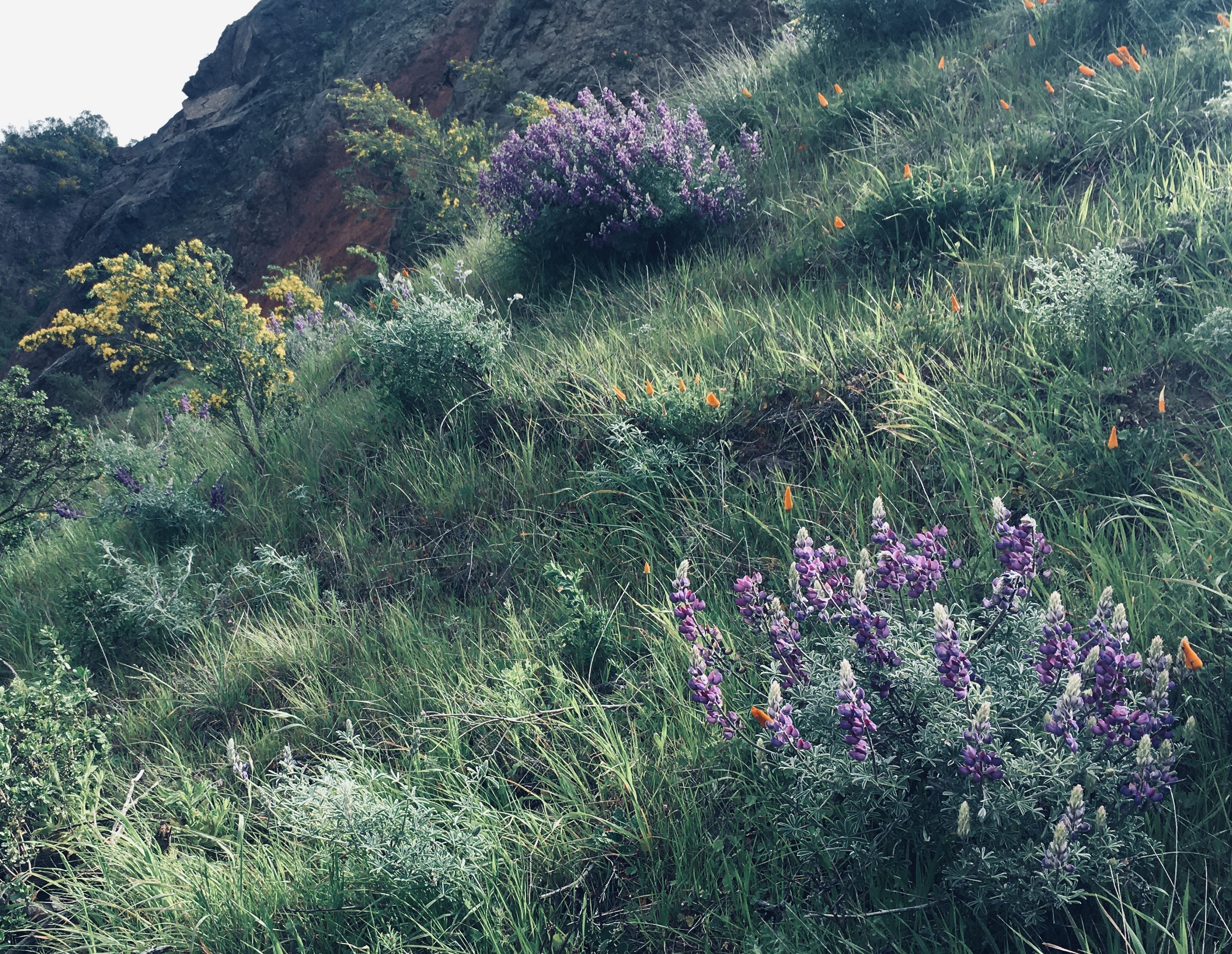
As hard as they worked though, our parents always seemed to manage to find time to show up for my brother and me, tag-teaming their presence when needed. The spring semester of my freshman year of high school, our biology teacher gave us an assignment to make a flower collection. We were each required to collect upwards of 25 wildflowers to individually press and identify in a book. The project was soon incorporated into our Isaacs’ family drives on Sabbath afternoons. We made a several trips logging dozens of miles but had difficulty finding more than a few kinds of wildflowers; primarily, the California poppies, which were illegal to be picked, and the brilliantly pink and purple lupines that dotted the sides of the road. The idea of reaching 25 flowers seemed impossible. My dad made a couple of extra trips with me into the foothills to help me with my collection. But I was stuck.
Feeling defeated, I approached my biology teacher back at school. I really loved him as a teacher and did not want to disappoint him. But I managed to tell him the challenges we were having finding wildflowers. Surprised, he asked me where and how we were looking. As I told him, he began to understand the problem. He asked if we had gotten out of the car to look or if we had only been looking from the car while driving by. I said that we had just been looking while driving. He said that was the problem, we needed to get out of the car and look for the small flowers that are not visible except up close. My family and I returned to the foothills with his instructions in mind. And within a matter of hours I was able to collect all the flowers I needed to complete my assignment. I hesitated to tell this story as I could feel a quality of embarrassment or shame that none of us thought to simply get out of the car. But as I consider what it meant that my tired and busy parents would even take this kind of time to help me find wildflowers the embarrassment dissolves into a well of deep gratitude. I only wish that they had not needed to work so hard so that even the task of finding flowers compelled us to work at top speed.
This story recently came to my mind as walking has been one of the only activities I have been able to do on a regular basis during the quarantine. I was never much of a walker before this last year. I would go on occasional hikes or backpacking trips. But the idea of simply walking around the neighborhood felt like a waste of time. Like, what is it for? And why spend time doing something so slow just to come back to where you started? If there was ever a time when my habits of mind around how I work and move in the world could be more starkly examined, it has been during COVID.
By contrast, my friend Nina has made walking a part of her practice of self-care for years prior to COVID. Walking is where she thinks and works out problems and befriends the place where she is. She always discovers pockets of weirdness and beauty wherever she goes. I began to walk with her late last spring. Being able to clip in to her well worn routes and then discover new ones together helped me early on in the shelter-in-place when I was spending days inside by myself. At the moment, we are averaging about 3 miles a day with loops we now describe in short-hand, including “going up to the Temple” and “going to the pond to see if the turtles are out.”
Our walks right now also include wildflowers. It is April as I write this and there is not a more beautiful time to be out in California. Every day, with news of increased vaccinations, hope seems to be returning to the world little by little as though it is riding on the slow minute-by-minute return of the light to our days. Even the smallest amount of good news is something we know to cherish now, like the rains we would like to be able to cherish if they would only come. This is the time of year that my family and I once tried to find wildflowers without knowing how to look for them. This year I am paying special attention to the littlest flowers I can find on my walks. Like our lives, these little flowers are not able to stay for long, even in the best of times. And the arrival of the wildflowers now, in this difficult time, feels even more fleeting, as bright and fleeting as light reflecting off the water, hitting your eye so fast and hard that you blink as though having accidentally looked into the sun. I want them to stay but they can’t.
So I am learning better how to see what is precious right here, right now, in the smallest ways. The future looms uncertain and I am trying not to sink into anticipatory grief over all that is yet unfinished with this virus, all that will be lost in this next fire season, how choked these skies will eventually become again, how many hearts will break anew. In the last verse of “Here in California,” Kate Wolf riffs on a familiar passage of Ecclesiastes: “To everything there is a season, to every purpose there’s a time. A time to love and come together, a time when love longs for air. A time for questions we can’t answer, though we ask them just the same.”
Whatever the times bring, I love you, California. I know the hills will turn brown in the summer. But I will be here the best I can for you and all who make their home here. I already love this fragile life better for the way I love you, here in California.


 Heather Isaacs
Leave a comment