One January morning several years ago, I drove a stretch of Hwy 29 more familiar to me than almost any other after years of traveling up and down the Napa Valley visiting hospice patients in their homes. But on that day, exhausted and soul-weary, I was on my way to a retreat in Mendocino where I hoped to find some rest and guidance. And for reasons unclear to me, I began to play a strange travel game in which I began to call to mind as many of those homes as I could. Every hospice worker and medical professional I know holds close to their hearts the memories of people who have touched their lives in ways that transcend the ordinary bounds of already intimate work. That morning, with the passing of every exit, cross street, and side road, I tried to remember every one of mine. But quickly, my mind became overwhelmed. Dozens of luminous faces began to shine in front of me, each face belonging to someone with whom I had been honored to share some small part of the beauty, pain, and mystery of their lives and deaths.
Their bright memories gathered together into a chorus of love and encouragement. At least, I like to believe these beautiful souls showed themselves (through the gift of imagination or spirit, I cannot say) to encourage me on, as though from their vantage point in death–like standing on a high mountain looking down at the way the terrain unfolds–they could now cheer me on in life as I had wanted to do for them in death as though we were all teammates in the same relay race. At a time in my life when I felt like I was waking up inside the same dark cave every morning, seeing these bright faces–real or imagined–gave me just enough light and encouragement to keep going. If there is such a thing as a cloud of witnesses, I absolutely count these people among mine.
But anyone who works closely to the suffering of others also carries another kind of cloud of witnesses in their hearts. More like a storm cloud or tornado, this is the gathering of faces of those remembered, in large part, because their suffering cannot be forgotten. Their suffering leaves another kind of mark on our memory. And remembering it feels more like a haunting.
Gratefully, in my experience of hospice, the number of these stories is much smaller than the first. Hospice care is incredibly effective at relieving pain and discomfort at the end of life. The great majority of people who die with the support of hospice care will do so in comfort. With good support, the dying process can bring us into contact with the deeper, unshakable truths of our lives–of Life itself–that ultimately help us to find our peace as we let go of this world. This is why there are so many stories of healing that paradoxically arise out of the dying process.
I remember one man–a father to a large blended family–sharing with me through his tears the epiphany of what it felt like to realize after all these years that he was truly loved. Some part of him doubted that truth his entire life–this was his spiritual pain (perhaps all of ours). But in dying, he finally learned the truth. He was loved. And in response, his heart broke open–not out of sadness, although his grief was great–but from the need to make way for a larger container to hold the love that was pouring into him now that he was finally ready to receive it.
The path to this kind of healing, however, becomes obstructed for some people. At least, for a time. Like a difficult childbirth–a process that is already characterized by hard labor–there are difficult deaths. And there are no easy shortcuts. An atheist co-worker recently told me that of all the deaths that she has witnessed, if she could testify that people who hold a belief in God have an qualitatively easier dying process than people who don’t, then maybe she would think there was some objective value in religion. But she couldn’t. Dying is hard. Our beliefs don’t spare us the painful work of letting go. It might be the hardest work of our lives. As the song says, “Don’t dismiss it like it’s easy. Tell me what’s so easy ’bout coming to say good-bye. You gonna miss her in the evening. You know we’ll all need somebody when you come to die.”
Occasionally though, forces of suffering can move like a natural disaster through a person’s body at a level where even the most powerful drugs seem impotent to stop them. The causes of this suffering are sometimes rooted in incomprehensible physical pain. But more often, this kind of intractable pain seems to be emotional and spiritual in origin. Like the time I witnessed a woman linger for weeks as her mind and body became flooded with a kind of terror that no amount of love from her beleaguered, frightened family or medical support seemed to relieve. A survivor of WWII bombings as a child, she seemed to be re-living the war all over again. I once walked into her room and this gracious, elegant woman recoiled like I was a phantasm, yelling at me to leave because I reminded her of death.
When she finally died, I struggled to know what I could have done differently to help her. When I shared this with my supervisor, she explained to me how spiritual pain is not like other forms of pain. You cannot give morphine to relieve spiritual agony. And whereas we can live for much of our lives without physical pain, everyone carries spiritual pain. For the most part, we are able to wall off spiritual pain and trauma behind coping mechanisms and defenses that help us to manage our lives. But the dying process has a way of stripping down all those walls and releasing our deepest demons without any of the tethers we once used to keep them under control. And physical medicine can’t really touch those demons. You will hear hospice nurses report in a state of angst and disbelief about the kinds of doses they are giving their patient to little or minimal effect in this state of terminal agitation. And sitting in the presence of extended, intractable suffering can undo even the most veteran of hospice workers.
The morning I was driving to Mendocino I was in the middle of one of those undoings. For months, I had been visiting Thomas* (not his real name), a man with early-onset dementia who was approaching the end of his life like someone being dragged to the edge of a cliff, digging his hands into the dirt hoping to find anything to hold onto. Terminal agitation was his norm. For months, rest was hard fought. Some days he slept. But many days he bucked like a wild horse, thrashing in bed, his brown eyes as wild as a cow’s facing slaughter. Without any family except for an estranged adult daughter who refused contact with her father, he relied on a couple of friends and neighbors who did their best to be there for him. But the hours in a day are long. And the journey of dementia is inhabited by many, many days. So Thomas spent much of that year alone or in the company of medical staff. Yet, even as he lost most of his language, his mind held on as long as possible to the same wish: to go home. Over and over he begged to go home and he couldn’t understand why he couldn’t. But there was no money or other resources to take him home. Home was gone.
Our hospice team gave everything it knew how to do to his care. For over a year, we did whatever was in our power to help Thomas be more comfortable, more peaceful. But pharmacological interventions only seemed to work for a little while before the agitation returned. And like a nurse exhausting the formulary, I felt every tool in my spiritual toolbox being used up. The suffering he was afflicted with was grotesque. He slowly lost weight. And his pale, clammy skin pulled tight against the bones of his skull. The dementia shredded his sense of what was real and unreal. Hallucinations chased him. Yet, most awful of all–he remained aware.
In my experience of observing people with dementia, it’s rare for me to ever feel that they are “not there.” I’ve been surprised too many times by what responses I’ve observed among dementia patients to ever underestimate again what they are able to perceive. I don’t know what the medical explanation is but to me it feels like dementia breaks the mirror through which we see ourselves and the world, leaving shards still able to reflect pieces of that former reality but only in disconnected fragments. Sometimes, bigger pieces of broken mirror remain, and for a moment the person with dementia can see themselves as they once were. And they “return” to that world for a moment before the image passes onto a smaller fragment of mirror and the big picture is lost once more.
But with Thomas, it felt like his mirror had broken into large pieces. This meant that at times, it appeared he could see himself and know was happening to his mind while also being caught in that confused and fragmented state of dementia consciousness. Sitting with him, I’ve never felt so completely and utterly helpless in the face of such suffering. Or, to be honest, repulsed.
When he would grasp my hand and plead for me to take him home, I sometimes felt the irrational fear that his sickness would infect me. There were days when the act of offering compassionate presence in the face of such horror was harder for me than I would like to admit. Many days, my heart opened in love. But there were many days, too, when it recoiled in fear and disgust. It wasn’t long before I felt stripped of every spiritual comfort. Some days, my only prayer would be to ask for the strength to simply stay in the room.
In those periods when he was able to rest, I always hoped this was the moment when everything would change, when he would finally be at peace. And there were moments of profound and unexpected grace when holding his hand and looking into his eyes seemed to be a ministry to both of us. I would sigh with relief, perhaps more for myself than for him. But every precious, hard-fought moment of rest was all too fragile and fleeting. Prayer felt meaningless. Not because I wondered where God was. I wasn’t asking that question. Rather, for the first time in my life, I was facing the possibility that not even God–in the way I had once believed–could help.
My entire life until that point I had believed love could save. That if you just loved someone hard enough, good enough, long enough that they would heal. Even if it meant martyring yourself like Jesus on the cross, love held the power to save. I believed in a life beyond this one in which God would heal everything and make all things new. I believed in a God with the power to snap his fingers and make everything all better. Whether God would was not a matter of having the power to heal–of course, God did–but a matter of God’s will. As a chaplain, I had consoled families–and myself–with the idea that even where there wasn’t a physical cure there was always the possibility of spiritual healing.
But now I was struggling with one of the most painful lessons of my life: What if love can’t save? What if love isn’t enough? What if all the power of the Universe embodied in my long-cherished beliefs about God is unable to love another into their own freedom and healing? Like the sun can shine on a closed box but no light will penetrate, what if love can’t force its way in? What if our minds can become so imprisoned–for reasons I do not judge or pretend to understand–that we effectively lock ourselves inside that box? Like the prisoners in Plato’s Allegory of the Cave, what if we remain locked in prisons of our minds even when there is an escape, even when we’re surrounded by all the human and divine help and love available to us, because we just aren’t able to see it?
You know those parts of yourself that will not let the love in? I know those parts in myself. The parts that have always felt monstrous and unlovable no matter how much I am loved and affirmed. The parts that can be standing in the light of the most gorgeous experience of love and still deny it’s happening. The parts that shout: “That kind of love can’t be real for someone like me.”
How does the love get in? How does someone turn towards the light? I don’t really know. I know it happens. I’ve seen it happen. And I want to tell you that it happened with Thomas. I want to tell you the happy version of this story, of the miraculous healing that the hospice team witnessed in those last days with this patient. I want to tell you that he experienced a beautiful reunion with his daughter. I want to share with you the awe I felt at his bedside when his spirit released into death with the lightness of a hummingbird.
But the story I am able to tell is not the one I wanted. Without much warning, he died a couple of weeks after I returned home from the retreat. In fact, he died on Valentine’s Day. He died with our social worker at his bedside and with me en route. At the time, knowing how much spiritual suffering he endured, I felt I had failed him as his chaplain. His death followed me home in a way no other death ever had before. For the first time in my life, I hoped there was no afterlife because I couldn’t be sure how his suffering would end any other way. If God didn’t heal this kind of pain in life, what made me think God would heal it in death? What if God couldn’t heal that kind of pain?
Several years have passed since that day. And though I am at greater peace with the idea that each person must find their own way to peace even when that way passes through hell, a part of me is still haunted by it. I look to the great spiritual teachers for answers and know that my journey of understanding has millions of miles to go. But every Valentine’s Day since his death, I have remembered him. When all the paper hearts and candies are floating in the ether with their promises of love, I remember how I first learned that love cannot save in the way I once believed. I remember how all I can do is to offer love in whatever form it arises in the moment and to surrender the outcome. I remember that I was his spiritual midwife, doing my best in my limited way to love and encourage him and to embody the truth that he was not alone. But I could not die for him. I could not take away his suffering.
Nor should I feel that is my responsibility. Every part of Thomas’ journey–even the unbearably horrific–was his. Perhaps he needed to fight and claw his way to the end. Perhaps his body offered itself as a protest against the circumstances of his life. Perhaps the reasons that estranged him from his daughter were ones he needed to wrestle with. In the Book of Genesis, Jacob wrestled all night with an angel of the Lord before he was able to receive his blessing. Perhaps we were only able to bear witness to Thomas’ fight with himself/God/Life. And we could only trust that there was blessing yet to be found.
This isn’t to say that I have given up on love. Love matters more to me now than ever before. But I continue to re-learn what love can and can’t do.
Last year, I spent time visiting a patient where she lived at Napa State Hospital. Though not technically a prison, the hospital is not a place people go to voluntarily. And it operates more like a prison where it houses the criminally insane behind its fences. Terry* (not her real name) herself was one of these patients. She had been a resident at Napa State for over a decade after committing a violent assault during a schizophrenic break. Her family was either dead or estranged except for an older brother who occasionally wrote letters. When she met the hospice team, she said that she hadn’t had any visitors in almost four years.
Terry didn’t talk about her terminal diagnosis of cancer. What she liked to talk about most was what she would like to do with her life when she finally got out of the hospital. With childlike enthusiasm, she shared her plans to start a soda-stand on the outside. Terry loved soda. Diet Coke, especially. Every time we visited, we would bring her Diet Coke. With a gentle spirit, she expressed gratitude for feeling safe and cared for by staff on the unit but also expressed her sadness that she wasn’t free to live the life she dreamed. And the possibility of life on the outside called to her even when it was clear that her body was not going to give her that option. Rather than try to dissuade her from this dream, we tried to enter it with her, to let the dream speak as a metaphor for what she was hoping for in her life–freedom and creative possibility and wholeness.
When Terry entered into the last days of her life, she became somewhat tense and restless. The nurse gave her comfort meds and I visited as often as I could. As she got close to the end, the hospice team moved into a state of pure vigil with her. One of the staff psychologists who had worked with Terry, too, joined us. Though Terry didn’t appear to be in pain, she didn’t look peaceful, either. I breathed with her and held silent prayer.
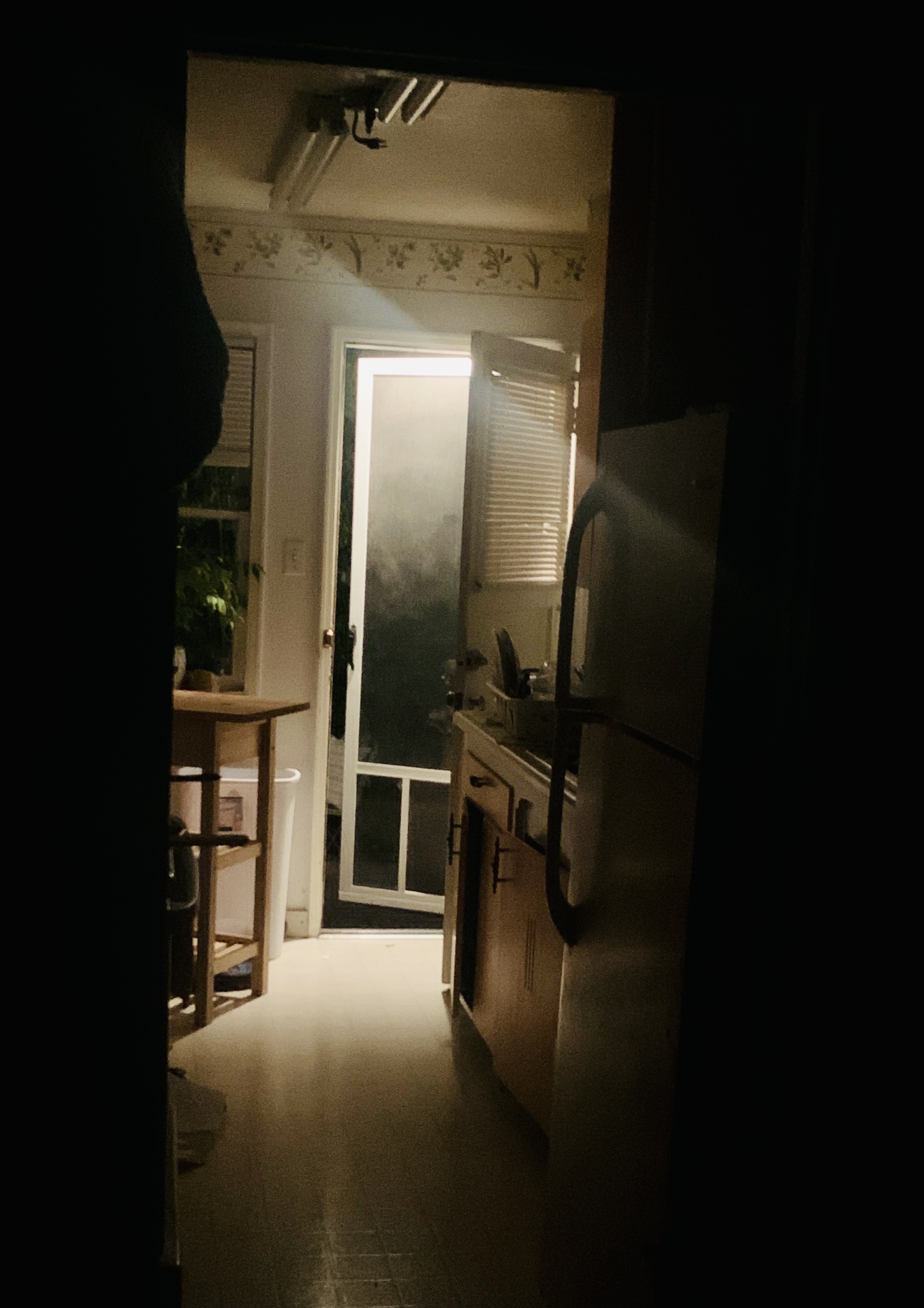
And in one of those strange moments that might mean everything or nothing at all, one of the nursing assistants walked into Terry’s room and without saying a word opened the door out into the courtyard. In the seven months I had visited Terry, I had never once seen that door opened. It was an unseasonably warm winter day. The sky was clear. The air felt clean and new. Why the nursing assistant opened the door right then I don’t know. But it felt like a tremendous gift from the Universe. Leaning down, I spoke softly into her ear: “Terry, the door is open. The door is open.” And almost immediately she began to relax. Until she took her last breath a few minutes later.
Every one of us sitting there at her bedside remained completely still until it felt like Terry’s presence was truly gone from the room. Until we knew she was finally “on the outside.”
What I learned that day and continue to learn–even as I hold with discomfort the memory of the suffering of patients like Thomas–is that when love isn’t enough it is still everything. It is everything we have to offer in the face of immense suffering. Love doesn’t break someone out of their mental prison. But maybe, just maybe, love helps open the door.
*Names and identifying characteristics of patients have been changed to protect confidentiality. Also, patient stories might represent a composite portrait.
 Heather Isaacs
Leave a comment